




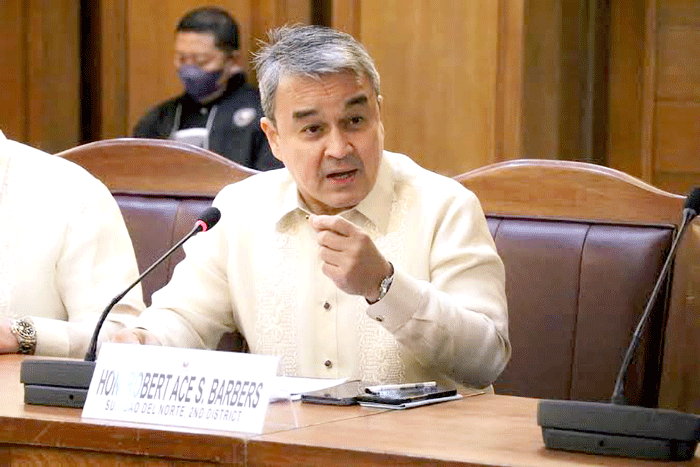

I have never sat down with former Surigao del Norte congressman Robert “Ace” Barbers for a personal conversation. My familiarity with him has largely come from what I have seen and read over the years – newspapers, television, online reports and, recently, social media. Like many politicians who have spent years in public life, Barbers has had his share of political controversies, strong statements and headline-making moments.
What caught my attention lately was seeing and hearing more of Barbers in his current role as adviser and spokesman of the House of Representatives’s Prosecution Panel in the impeachment trial against Vice President Sara Duterte. His frequent media appearances have put him back in the national spotlight, this time explaining, defending, and articulating the stand of the House prosecution team in the country’s most closely watched constitutional proceedings.
That prompted me to look beyond the sound bites and revisit the politician behind the current headlines. Who exactly is Robert Ace Barbers? What did he do before becoming a familiar face in the impeachment proceedings? How did a politician who began his career in provincial government find himself involved in some of the most consequential congressional probes and constitutional issues of the day?
The answers, as I discovered, make for an interesting political journey. Barbers has been a governor, a six-term congressman, a committee chair, the lead chair of the controversial House Quad Committee, and now an adviser and spokesman in an impeachment trial before the Senate Impeachment Court (SIC). Each position placed him in a different part of government and exposed him to a different kind of public responsibility.
Whether these experiences will lead Barbers to seek another national post is a question rather than a conclusion. But with the 2028 elections gradually entering the political conversation, his name is worth looking at—not as a candidate to endorse or oppose, but as a politician whose long public record provides enough material to examine where he has been, what he has done, and what kind of public figure he has become.
Robert Ace Barbers has spent his public life moving between three arenas of government: Executive and administration, legislation and oversight, and constitutional accountability. His first major experience in executive government came as governor of Surigao del Norte. Running a province requires a different kind of political and administrative discipline—one measured not by speeches or committee hearings but by the delivery of programs, services and projects. It gave the young Barbers, the son of the late Sen. Robert “Bobby” Barbers, an early grounding in the practical realities of government.
He subsequently returned to Congress, where he spent six terms representing Surigao del Norte. There, his work increasingly centered on legislation, public safety and government oversight.
Congressional records show his membership in committees dealing with national defense and security, public order, dangerous drugs, public accounts, foreign affairs, natural resources, ways and means and tourism.
One of the defining assignments of his congressional career came when he chaired the House Committee on Dangerous Drugs and later the House Quadrilateral Committee (QuadCom) . The latter brought together four major House panels to investigate interconnected issues involving illegal drugs, POGOs, public accounts, public order and human rights.
The QuadCom hearings placed Barbers at the center of a highly consequential national probe. The panel was not simply about conducting hearings. Its stated objective was to examine possible connections among issues that had traditionally been investigated separately. Witnesses were called, documents examined and government agencies placed under scrutiny. The hearings generated information that could be used not only for possible government action but also for legislation.
By the end of 2024, the House reported that the QuadCom had held a series of 12 public hearings and produced five major legislative proposals, dealing with such matters as extrajudicial killings, offshore gaming operations, espionage, civil forfeiture and fraudulent birth certificates. Whatever the controversies surrounding the hearings, QuadCom showed the way congressional probes can be used as a bridge between oversight and legislation.
The experience also gave him a reputation for direct, sometimes combative questioning and an ability to translate complicated probes into issues ordinary Filipinos could understand. More importantly, it demonstrated the role of congressional oversight in identifying policy gaps and converting the findings of investigations into proposed legislative remedies.
That experience now forms part of the background to Barbers’ latest national role. In June 2026, the House Prosecution Panel named him an additional spokesman and adviser for the impeachment trial of Sara Duterte. The House cited his decades of legislative experience, public-accountability work and communication skills in announcing the appointment.
The assignment has given Barbers another, very different platform: explaining a constitutional process to the public. Rather than debating legislation or questioning witnesses in a congressional investigation, he now operates within the rules of an impeachment court, where the SIC exercises its constitutional function of trying impeachment cases. That role has also tested his ability to balance advocacy with procedural discipline. When the SIC imposed restrictions under Rule 18 on public comments concerning the merits of the case, Barbers said the prosecution would comply and that the rules should apply equally to those covered by them.
The solon from Mindanao has nevertheless continued to emphasize the importance of keeping the public informed about what happens inside the impeachment court. Barbers has argued that factual accounts of proceedings should remain accessible to Filipinos who cannot follow hours of hearings, particularly in an environment where misinformation can easily circulate.
Across these different assignments, a recognizable pattern emerges. Seen chronologically, the trajectory is straightforward. Governance taught him the demands of executive administration. Legislation and oversight gave him experience in making policy and scrutinizing the government. The QuadCom exposed him to complex national investigations. The impeachment proceedings have placed him within the country’s highest constitutional accountability mechanism.
Whether that accumulated experience will eventually lead him to seek a Senate seat in the May 2028 elections remains a question for another day. For now, his public record provides a fairly
clear picture of a politician whose career has been shaped by three recurring themes: governance, oversight and accountability.
Perhaps, that is the more interesting way to look at Ace Barbers – not simply as another name that could appear on a future Senate ballot, but as a politician whose career has steadily moved toward increasingly national and consequential responsibilities. For a Mindanaoan politician contemplating another national chapter, that accumulated experience is perhaps the most relevant part of the story- and one that voters can ultimately assess for themselves.
