




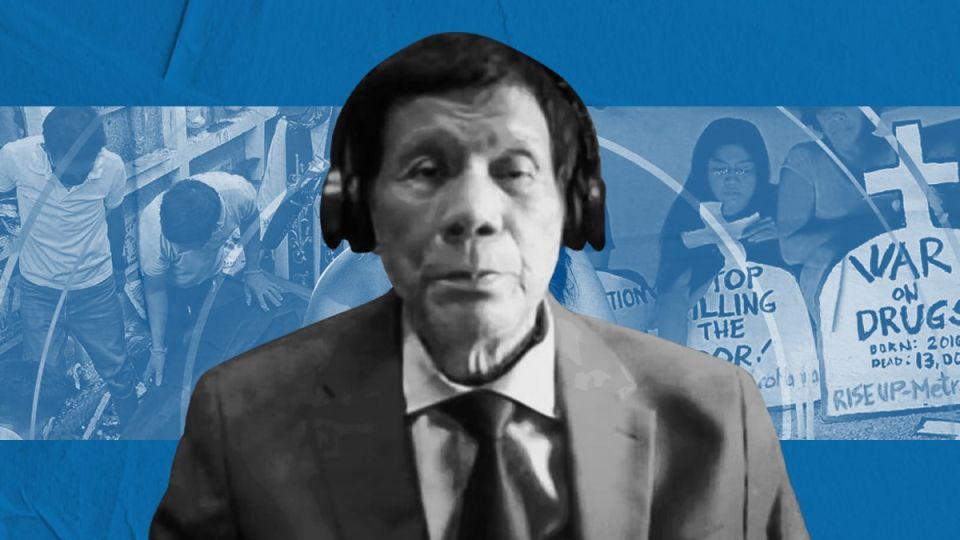

ON Nov. 30, a Monday, while the Philippines celebrate All Heroes’ Day, a holiday, the trial of Rodrigo Duterte, will start promptly at 10 am, The Hague time, which is behind by six hours over Philippine time. The following constitutes the last of the three additional chapters in the revised and updated third edition of my book, “KILL KILL KILL Extrajudicial Killings in the Philippines; Crimes Against Humanity v. Rodrigo Duterte Et. Al.”
BY all means, the much hyped and anticipated trial of Rodrigo Duterte by the ICC Trial Chamber III will proceed on Nov. 30, 2016. By all means, it will generate global attention as Duterte has been identified as a mass murderer by the global mass media. Duterte faces crimes against humanity charges, which Sonny Trillanes and Gary Alejano, a pair of former lawmakers, have initiated along with several leftwing organizations, including the National Union of People’s Lawyers (NUPL). It was their reaction to Duterte’s initiative to order the murder of thousands of suspected drug addicts, street peddlers, and petty criminals.
On Nov. 30, 2026, a Monday, at 10:00 a.m. The Hague time, or 5:00 p.m. Manila time, Rodrigo Duterte will face Trial Chamber III composed of Presiding Judge Joanna Korner of the United Kingdom, and Associate Judges Paek Keebong Paek of South Korea and Nicolas Guillou of France. This is the start of the trial, which will have four one-hour sessions per day (10-11am; 11:30am-12:30pm; one-hour lunch break; 1:30-2:30pm; and 3-4 pm, The Hague time. The proceedings will be streamed on ICC website, Facebook, and YouTube with a 30-minute delay. The public gallery is open but it will have limited capacity and guests will be welcome on a first-come basis.
The Oct. 30 ICC media advisory gave the scenario on the day of the opening proceedings. On the verification and plea, the Trial Chamber III first verifies if Duterte understands the nature of charges against him. He will be asked whether he makes admission of guilt or pleads not guilty. This is no different from the process of arraignment in the Philippine court system.
Under Article 63 Rome Statute, the accused “shall be present during trial.” The ICC expects him to attend daily in person. He was excused from the Nov. 2 final status conference, but the ICC Registry warned unexplained absences could fuel disinformation. The victims’ interest in the trial is of “paramount importance.” That is the reason his presence is required. The video-link from his detention facility is possible only if the Trial Chamber III approves.
Both the prosecution and defense panels will be allowed to give opening statements. A total of nine hours will be given to the two sides and their opening statements will be spread over days. The prosecution team will deliver their first opening statement and they will be given six hours. The Common Legal Representatives of Victims (CLRV) will follow the prosecution and they will be given three hours. The defense will give their opening statement immediately before presenting its evidence, but their allotted time has yet to be fixed.
The victims’ lawyers request to use Tagalog for certain portions was rejected. Their testimonies should be in English. The ICC uses only English and French as its working languages. Besides, the ICC Trial Chamber III knows that an overwhelming majority of Filipinos speak and understand English. It knows that English is a successful second language in the Philippines.
The first prosecution witness i: scheduled to start testifying after opening statements. Its schedule is adjusted on a case to case basis. The prosecution has filed an updated witness list on Nov. 6. Some witnesses may testify via audio-video link, but their names and number will be kept confidential by the Trial Chamber. The charges against Duterte has beeen confirmed on April 23, 2026 by the ICC Pretrial Chamber I afterwhich the Trial Chamber III has taken over.
Crimes against humanity of murder and attempted murder under Article 7(1)(a) Rome Statute, allegedly as part of widespread and systematic attack against civilian population in Philippines, Nov. 1, 2011 – March 16, 2019 – period the Philippines was still member state to the Rome Statute before its withdrawal took effect.
Duterte faced three counts of murder under the following eras:
Count 1: Murder in Davao City during mayoral period, 2013 to June 2016 – Davao Death Squad pattern;
Count 2: Murder of “High-Value Targets” across Philippines during presidency, July 2016 – July 2017; and
Count 3: Murder and attempted murder during barangay clearance operations across Philippines, July 2016 – Sept. 2018.
The prosecution has raised as its main theory: Duterte was allegedly individually responsible as indirect co-perpetrator. He did not personally shoot victims, but he designed, ordered, encouraged, and protected a system of organized violence against suspected drugs addicts, traders, and petty criminals. There was no rule of law. He did not bring the victims to the bar of justice, but he resorted to their extrajudicial killings.
The prosecution is required to prove beyond reasonable doubt. For its part, the defense will test and challenge the credibility, reliability, and present its own case after prosecution and victims’ observations. Pretrial skirmishes signal the defense strategy. In its Nov. 6-8 filings, Peter Haynes, the defense lawyer, opposed the prosecution’s late expert report by witness P-1400 (field redacted, expected to be early prosecution witness).
Haynes also opposed 15 associated items under Rule 68(3), as he argued that late submission affects Duterte’s ability to prepare, and that report tries to indirectly introduce studies by non-witness professionals. He asked the Trial Chamber to dismiss or defer them. That is something typical. It is expected to have lengthy admissibility, witness-protection, and redaction battles, with some sessions private and closed to protect witnesses.
Duterte has not been convicted. His trial is meant to determine his guilt.
It is significant in the sense the trial is a way to stop mass murder by a leader. This is not just a Philippine case. It is also a test of three principles:
First, the complementarity rule, which means any national failure triggers international jurisdiction. The ICC only acts when national courts are unwilling or unable to take over The Philippines, under Duterte and after did not prosecute these killings. There were only five convictions out of thousands per the EJK Truth Commission. Most cases were filed as Deaths Under Investigation (DUI). If the ICC can proceed despite the 2019 withdrawal of the Philippines from the Rome Statute in 2019, it signals that the withdrawal of any country does not erase liability for crimes committed while a state was a party. That closes a loophole leaders might use, which is to quit the International Criminal Court to escape responsibility.
Hence, any head-of-state, or former head-of-state has no immunity for crimes against humanity. Duterte is the first former Asian head of state to face ICC trial for the antidrug war killings, and one of few former presidents ever to stand trial in The Hague. It tests whether “war on drugs,” “war on crime,” or “national security” can be used as the legal cover for systematic killing of civilians. The prosecution panel should prove what could be regarded as widespread and systematic, not isolated excesses, but policy as well.
If convicted, it would be precedent that a leader, who creates an incentive infrastructure like quotas, rewards, public encouragement to kill, protection from prosecution can be liable even without pulling the trigger. If acquitted, it would be precedent to show that the ICC requires direct linkage, not just rhetoric and statistics.
Under the ICC trial, the victims are participants. They are not just witnesses. Unlike the Nuremberg Trials or ad hoc tribunals like the International Criminal Tribunal for the former Yugoslavia, the Rome Statute gives victims, or their families, the legal representatives, who can present views, concerns, and possibly evidence. The EJK Truth Commission, which was formed on May 2026, has been explicitly created to complement this role, which is to document cases the ICC cannot cover because of its limited time frame and limited number of victims (e.g., Clarita Alia’s sons 2001-2007, Christian Pepaño 2020).
The Nov. 30 trial opening will be watched in Manila by families, who testified in Aug-Oct sessions. For them, the ICC is the only court that has moved. This is a big deal for them – or the only deal that matters.
There is also a strong argument for deterrence against backlash risk. Supporters have argued that a public trial with live testimonies by witnesses, forensic evidence, and cross-examination creates a historical record that deters future leaders from using mass killing as policy, and rehabilitates institutions. There is no argument that the trial will be unsuccessful.
