




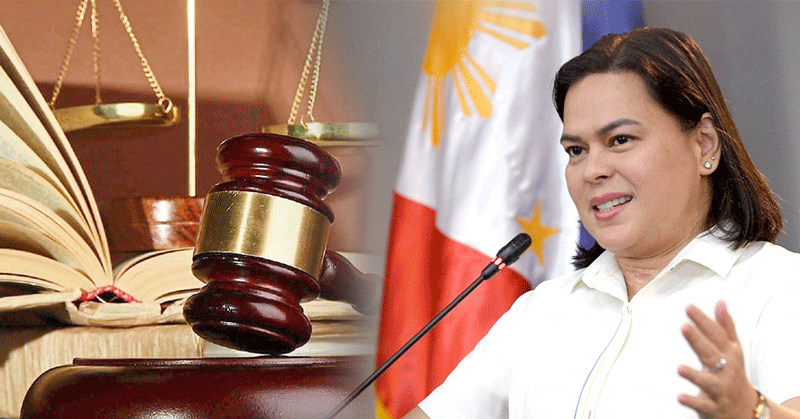

DON’T be taken by the effrontery of a sophomoric, albeit untalented, radio commentator, who openly claimed that his voice represented public opinion in the country. Public opinion is a far more complicated concept to be understood and discerned easily by simpletons like that radio commentator. It involves a complex process that could render many of us witless by its dizzying pace.
Public opinion, also called popular opinion, represents the collective opinion on a given topic or subject matter. Public opinion is not the personal opinion of a popular radio commentator, as it goes beyond his opinion. Public opinion represents the numerous voices flowing in a single stream. It represents the institutional voices, the sectoral voices, and, finally, the personal voices of persons, who are widely regarded as opinion leaders. The key to understanding it is that public opinion represents the many voices flowing in a single stream.
Mass media outfits heavily influence the crystallization of the many voices to jell into what we commonly refer as public opinion. The sheer mass media coverage of the views and opinions of opinion leaders like experts, officials and former officials who represent specific posts of power and expertise, officials and representatives of certain public offices, civil society organizations, and private sector firms contribute to the creation and formation of public opinion.
Mass media commenters contribute to the dynamics in the formation of public opinion. Without them, it is inconceivable how public opinion would ever emerge to stimulate and scintillate the public imagination. Although simplistic in its presentation, the social mobilization theory connotes that public events lead to public reaction and it further cultivates the beyond the news genre, which is public opinion.
Take the issue of the impeachment trial of Misfit Sara. It is far more complicated and complex than we could have originally thought. It involves twists and turns, false steps and supposed dead ends only to surprise us by the emergence of many possibilities and raw emotions. It offers lessons on the dynamics of a social phenomenon typical in the field of sociology.
It all started when the QuadComm composed of the House of Representatives’ four committees – dangerous drugs, public safety and order, human rights, and public accounts – conducted a joint inquiry last year of several topics and issues that included Misfit Sara’s alleged misuse of P612 million in confidential funds given to the Office of the Vice President (OVP), which she still heads as the vice president, and Department of Education (Deped), which she then headed for two years.
It was an ordinary congressional inquiry, but her refusal to appear and testify before the QuadComm triggered controversy, prompting the House leadership to spin off a separate committee, the Committee on Good Governance, which was then chaired by Rep. Joel Chan of Manila to probe deeply the anomalies confronting her Again, Misfit Sara refused to show up and testify, leaving many things to her subordinates including the clueless Zuleika Lopez, her chief of staff at the OVP and Deped.
The controversy created by Misfit Sara’s nonappearance at the QuadComm and Chua Committee somehow culminated when the House of Representatives submitted to the Senate the Articles of Impeachment signed by its 240 members of the 19th Congress. But it was only the beginning of a new controversy. The issue was further complicated when her camp petitioned the Supreme Court to declare as “unconstitutional” her impending impeachment trial and stop the Senate as an impeachment court from proceeding to hold a public trial on her.
The Supreme Court, after four or five months of inactivity, suddenly came back to life and on July 25, it came out with a controversial decision declaring as unconstitutional her impending impeachment trial and virtually stopping any public trial by the Senate impeachment court. Henceforth, hell broke loose. Misfit Sara could hardly contain the process to crystallize at her expense the public opinion on her impeachment trial.
Misfit Sara’s political agenda is summed up in a single line: Stop any impeachment trial at all costs. Her camp foresaw that any impeachment trial by the Senate could be beyond its control, as the 11-man Prosecution Panel from the House has intended to unravel before the public the tons of evidence they have culled and collected for presentation before the appropriate forum, which is the Senate impeachment court.
Hence, they foresaw that they would never control how public opinion would spin. They know they would be helpless, powerless, and witless to handle public opinion. It is now happening as the dynamics of public opinion take charge on the controversy of the Supreme Court’s verdict on her political fate.
The first to come were the so-called “influencers” in social media platforms and they voiced their unalloyed refusal to accept the High Court’s decision. On the basis of their understanding of the High Court’s press statement and from the soft copy of the verdict, they questioned the arguments in the ponencia of Associate Justice Marvic Leonen. They questioned the perceived haste and lack of due process in ironing out the verdict. There were no memorandums, no oral arguments, and no resolutions whatsoever.
Subsequently, the personal voices of public accepted experts from the legal community came to oppose Leonen’s ponencia – retired Supreme Court Associate Justice and member of the 1986 constitutional commission that drafted the 1987 Constitution Adolf Azcuna (he authored the constitutional provision on impeachment and public accountability of state officials); retired Supreme Court Associate Justice Conchita Carpio Morales (she wrote the ponencia on the Francisco case in 2012); and retired Associate Justice Antonio Carpio.
Their opposing voices carry enormous weight as they opposed the new judicial doctrine posited by the Leonen ponencia, which invariably changed the rules on how impeachment would be filed and proceed. Moreover, their opposing voices represented the finer points of law, which the Leonen ponencia has overlooked. They also spoke of judicial overreach, which is a big no-no among jurists as it could connote the abuse of power or even encroachment on the power of other branches of government.
The solid opposition has been further compounded by the single voice of retired Chief Justice Reynato Puno, whose rejoinder was being presented as the voice of the organization he represents – the Philippine Constitution Association (Philconsa), the organization of lawyers, whose expertise is constitutional law. Puno decried what he and Philconsa perceived not only judicial overreach, but judicial activism as well. It connotes the High Court’s tendency to legislate, a power that rightfully belongs to Congress.
The institutional voices have been expressed and given by the Faculty of Law in the University of the Philippines Law School, the various law schools lawyers’ organizations, including those based in Davao City, Misfit Sara’s registered domicile, and other political parties and civil society organizations like Akbayan Party List, Bayan Muna, Samahang Magdalo, and newly formed coalitions tasked to oppose the decision. They continue to churn various opinions against the decision and the Supreme Court appears helpless at the moment to oppose it. The House of Representatives has filed a motion for reconsideration and the Senate impeachment court was reportedly bent to suspend any proceeding.
Many things could happen as the dynamics of public opinion continue to show unmitigated movement. The public itself could be either fascinated or amazed by such dynamism in an open and democratic country like ours.
