




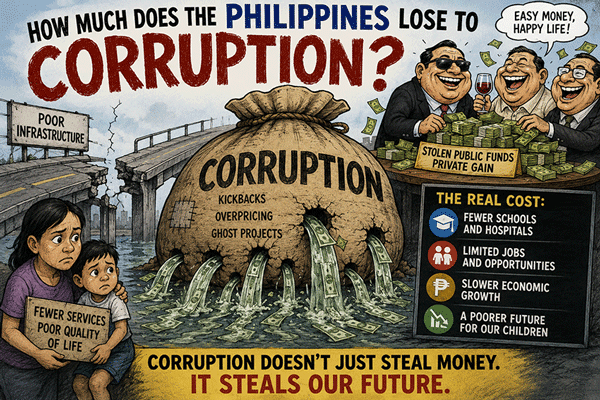

ESTIMATES of losses in corruption activity in the Philippines vary. But they are nevertheless big by any stretch of imagination, reflecting the sordid systemic failure to combat plunder of the people’s money.
That the Philippines is a weak state with a weak spine or political system (institutions and processes) to combat corruption is best illustrated by estimates of losses.
The World Bank, for instance, estimated corruption cost at around 5% of the country’s Gross Domestic Product (GDP) annually. Hence, if the Philippines’ GDP stands at an annual average of P32.7 trillion, the amount lost to corruption could be around P1.635 trillion.
This is much higher than the estimated P700 billion losses, but this estimate is essentially based on the annual national budget. The estimated annual loss of P1.635 trillion has a wider base-estimate, as it includes private sector leakage, inefficiency, and not only budget diversion.
On the losses in the flood control scandal, which no less than President Ferdinand Marcos Jr. revealed in his 2025 State of the Nation Address (SONA), the government lost an annual average of P118.5 billion for three years, 2023-2025, according to then Finance Secretary and now Executive Secretary Rafael Recto.
Over the last five or six decades, large scale corruption has haunted Philippine politics. This unwanted development reflects a failure in governance, which engulfs the country into further underdevelopment. The public funds for development were stolen by conspiring public officials, who were its supposed guardians, and private citizens, who were in cahoots with corrupt state officials.
Corruption is a vicious attack on the country’s democratic way of life. Because of corruption, the public funds for public services like health, education, infrastructure, and other development projects, are diverted and go instead to the pockets of corrupt officials and allies. The people are their witting and unwitting victims.
Corrupt officials, mostly those politicians, or officials in the executive positions, and corporate officers of state-owned corporations, are bigtime winners, while the people end up losers. Corruption is the abuse of state power for private gain.
Corruption happens when a state official or a lowly employee uses his power or office to solicit bribes or favor. This only represents a side of corruption. The other side involves private persons and state functionaries, who influence policymaking to gain an undue competitive advantage or secure profitable state contracts. Corruption involves the two despicable sides of the same coin.
In 2018, then Deputy Ombudsman Cyril Ramos claimed that the government lost as much as P700 billion every year as corruption cuts across various sectors. Ramos cited the persistent 20% loss in the national budget. Of this figure, as much as P100 million could be lost everyday due to systemic losses.
There were calculations that if the national budget stood at between P5-6 trillion in 2024-25, the losses could reach between P1.0 to P1.2 trillion, making the estimate of P700 losses as something irrelevant.
